For many homebuyers, saving for a down payment is one of the biggest obstacles on the path to homeownership.
Whether you're planning to buy your first home in Rockford, Loves Park, Machesney Park, Roscoe, Rockton, Belvidere, or elsewhere in Winnebago County, building a down payment fund takes time, discipline, and a smart savings strategy.
Once you begin setting money aside, an important question arises:
Where should you keep your down payment savings?
The ideal place should help your money grow while still keeping it safe and accessible when you're ready to buy.
Summary
The best place to keep your down payment savings depends largely on when you plan to purchase a home.
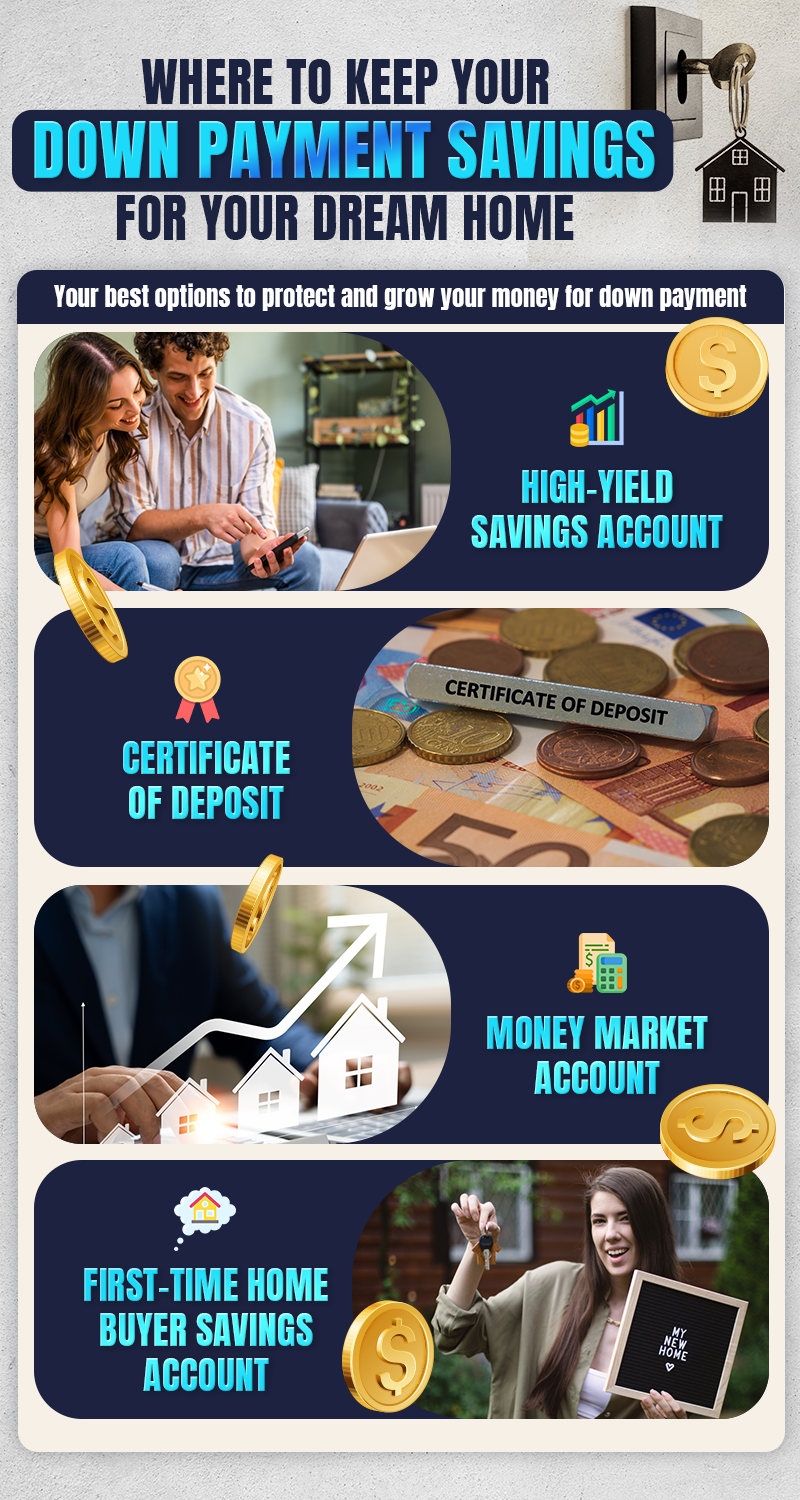
Popular options include:
High-yield savings accounts
Certificates of deposit (CDs)
Money market accounts
First-time homebuyer savings programs
The closer you are to buying a home, the more important liquidity and accessibility become.
Certificate of Deposit
Best for: Buyers who want to lock in today's higher interest rates but are still far out from purchasing a home.
Possible downside/s:
Your money is less accessible, so if you withdraw from your account before your certificate of deposit matures, you’ll most likely have to pay an early withdrawal penalty.
Interest rates can increase with a HYSA, while a CD stays at the same rate you invested at.
A certificate of deposit, also called a CD for short, is another great option if you’re looking for a safe place to store your down payment savings. Like HYSAs, CDs tend to offer an attractive fixed rate and earn higher returns compared to traditional savings accounts. As of March 2026, the best CDs on the market offer as high as 4.10 percent APY.
If you’re 12 to 24 months (or more) away from buying your dream home, choosing a CD may make more sense. You could lock in today’s higher interest rates and earn a bit while you continue saving for a down payment, as long as you leave your money in your account for the duration of the CD term.
Here’s where the biggest downside comes in: your money is less accessible in a CD. Your money is already tied up for a specific time period, whether it's six months or a year. So if you withdraw money from your account before your CD matures, you’ll most likely have to pay an early withdrawal penalty. If you’re looking to settle down real soon, CDs aren't your best option. Though penalties vary by institution and CD type, you can expect to lose months’ worth of interest if you break a CD early, often negating whatever gains you picked up when choosing the CD in the first place.
Money market account
Best for: Buyers who prefer an account for both spending and saving for a down payment on a mortgage.
Possible downside/s:
You might mix up your spending money with your savings, which could be a huge drawback if you're working to save a large sum of money.
A money market account (MMA) might benefit you better if you want a deposit account that gives you the ability to spend money while setting aside savings for a down payment on your next home. Some of the best MMAs from banks or credit unions offer competitive (variable) interest rates in line with what you'd earn with an HYSA or short-term CD. The balance you keep in your account earns interest, while also having perks like debit cards and ATM access, and even check-writing capabilities. This means you can withdraw your funds at any time, allowing easy access to your money.
First-time home buyer savings account
Best for: First-time home buyers who want to save for a down payment on a home and take advantage of state tax deductions.
Possible downside/s:
You may have to pay taxes, along with potential penalties, if you use the funds for non-approved home-buying expenses.
There is usually a maximum annual contribution limit, and possibly a lifetime contribution cap, which varies depending on where you live.
A first-time homebuyer savings account, or FHSA, is a special type of savings account offered by certain states. It is designed to help home buyers save money for home-buying expenses, such as a down payment or closing costs, while taking advantage of state tax deductions.
Contributions to an FHSA are tax-deductible at the state level, meaning you can reduce your taxable income by the amount you save in the account, up to your state's limit. Each program has its own criteria, outlining how much you can save, when you have to use it by, and any penalties for early withdrawal. Many of these accounts also offer favorable interest rates, yielding you a larger return on your money than you would with many other savings accounts. Plus, the interest you earn on the balance may also be tax-free or deferred until withdrawal.
However, it’s important to remember that you can only spend the money in this account to cover any approved home-buying expenses, such as a down payment, closing costs, real estate agent fees, appraisals, or home inspections.
Your home-buying timeline plays a major role in deciding where to keep your down payment savings. If you're planning to purchase a home in the near future, accessibility to your funds becomes more important than choosing an account with a slightly higher interest rate. This is especially crucial in today’s housing market, where inventory can be limited, and desirable homes might move quickly. If your timeline remains unclear, your priority should be the flexibility of your funds. You need to be ready to act when the right property appears, especially this coming spring, which is peak real estate season.
Bottom Line: Which Should You Choose?
Saving for a home takes planning, patience, and consistency.
Choosing the right place to keep your down payment fund can help your savings grow while ensuring the money remains available when it's time to buy.
Whether you're purchasing your first home in Rockford, Loves Park, Machesney Park, Roscoe, Rockton, Belvidere, or elsewhere in Winnebago County, having a clear savings strategy can make the homebuying process significantly less stressful.
Frequently Asked Questions
Where should I keep money for a house down payment?
Many buyers choose high-yield savings accounts, money market accounts, or certificates of deposit depending on their timeline and goals.
Is a high-yield savings account good for a down payment fund?
Yes. High-yield savings accounts provide easy access to funds while allowing your money to earn interest.
Should I invest my down payment savings?
If you plan to buy a home soon, lower-risk savings vehicles are often preferred because market fluctuations could impact your available funds.
Do VA loans require a down payment?
Many eligible veterans can purchase a home using a VA loan without a down payment.
How much should I save before buying a home?
In addition to a down payment, buyers should budget for closing costs, inspections, moving expenses, and emergency reserves.
What is the safest place to keep my home savings?
FDIC-insured bank accounts and NCUA-insured credit union accounts are among the safest places to store down payment funds.